
You may have been told you would benefit from prism glasses. If you’re a contact lens wearer, you may also be wondering whether prism correction is available for your specific eye condition in contacts, too.
The short answer is yes, prism contact lenses do exist in certain specialty designs. However, contacts with the prism are not the same as standard soft contact lenses. Prism contact lenses may be worth exploring for patients with Binocular Vision Dysfunction (BVD), double vision, eye strain, or other eye alignment symptoms who prefer contact lenses over glasses.
Today, we’ll cover what prism contacts are, how they work, what the research says, and what contact lens wearers should know before choosing between prism glasses and prism contact lenses.
What Are Prism Contacts?
Prism contacts are specialty contact lenses designed to incorporate prism correction. Prism correction changes how light enters the eyes so the brain can better align images from both eyes. In standard contact lenses, the goal is usually to correct refractive errors such as:
- Nearsightedness
- Farsightedness
- Astigmatism
- Presbyopia
Prism contact lenses are different because they are designed to address image alignment, not just clarity. This makes them relevant for some patients with binocular double vision, small eye misalignments, or certain types of strabismus.
However, the phrase “prism contacts” can be confusing because prism is also used in some contact lenses for stabilization. For example, some toric contact lenses use prism ballast to help the lens stay properly oriented on the eye. That is not the same as using prism to treat double vision or binocular vision symptoms.
How Does a Prism Work In Eye Care?
Prisms bend light before it enters the eye. Instead of forcing the eye muscles to work harder to align two images, the prism shifts an image and improve alignment eyes and brain can process visual information more comfortably. Prisms are commonly used to help manage symptoms related to eye misalignment, including:
- Double vision
- Eye strain
- Headaches
- Visual fatigue
- Difficulty focusing
- Reduced depth perception
- Symptoms related to binocular vision dysfunction
Prism power is measured in prism diopters. The amount and direction of the prism must be customized to the patient’s specific eye alignment needs.
Do They Make Prism Contacts?
Yes, they do make prism contacts, but they are not widely available in the same way as standard contact lenses. Prisms can be incorporated into certain custom soft contact lenses or scleral contact lenses. These lenses are typically designed by specialty contact lens providers and require detailed measurements, careful fitting, and follow-up testing.
Research on prism contacts is still limited, but emerging studies suggest that they may help some patients with small-angle binocular diplopia. A 2023 study evaluated custom soft directional prismatic contact lenses (not yet commercially available) in patients with strabismus. The study found that the lenses resolved diplopia in all patients, and they reported higher vision quality with the prism contacts.
Prism contacts are not yet a universal solution for every patient who needs prism. For more context and information on the mechanics, learn more about what prism glasses are.
Contacts With a Prism vs. Prism Glasses
For many patients, prism glasses are a practical option because they can be adjusted, tested, and prescribed with a high degree of precision. Prism contacts may offer benefits for some patients, but it’s important to understand the differences between them and glasses.
| Feature | Prism Glasses | Prism Contacts |
| Availability | More common | Specialty option |
| Adjustability | Easier to adjust | More complex to modify |
| Prescription flexibility | Can support many prism directions and powers | More limited depending on lens type |
| Contact lens care | Not needed | Requires daily lens care |
| Best use case | BVD, eye strain, double vision, ongoing prism needs | Select cases of diplopia or specialty contact lens needs |
Prism glasses may be especially helpful for patients with BVD because small amounts of prism can be measured and refined based on symptoms, visual comfort, and binocular function.
For patients who are athletes or active individuals, micro-prism lenses may also support visual comfort and performance. Learn more in how micro-prism lenses can up your game
Prism Contacts for Double Vision
Prism contacts for double vision may be considered when double vision is binocular, meaning it occurs because the two eyes are not aligned properly. Prism contacts may be explored for some cases involving:
- Small-angle strabismus
- Vertical diplopia
- NOT TRUE as of this writing – only vertical and strabismus corrections
- Certain decompensated phorias
- Some post-surgical or post-traumatic eye alignment problems
- Select specialty contact lens cases
However, prism contacts are not appropriate for all types of double vision. Sudden double vision, worsening double vision, or double vision associated with neurological symptoms should be evaluated promptly by a medical provider.
Can Prism Contacts Help BVD?
Prism contacts may help some binocular vision problems, but they are not typically the first-line solution for many patients with BVD.
Binocular Vision Dysfunction occurs when the eyes struggle to work together comfortably as a team. The misalignment may be very subtle, which means symptoms can be significant even when the eyes appear normal. Common BVD symptoms include:
- Headaches and eye strain
- Dizziness
- Motion sickness or sensitivity
- Difficulty reading
- Neck pain
- Light sensitivity
- Trouble using screens
- Anxiety in visually busy environments
For BVD, prism glasses or micro-prism lenses are often preferred because they allow the doctor to make precise adjustments to the prism prescription. Some patients may use prism glasses full time, while others may wear prism glasses over contacts in certain situations.
Why Prism Contacts Are A Bit More Involved Than Regular Contacts
Prism contacts must do more than correct blurry vision. They must also stay stable on the eye so the prism remains in the correct direction. This matters because prism correction depends on orientation. If the lens rotates or shifts too much, the prism effect may not work as intended.
That is one reason scleral lenses may sometimes be used for more complex prism contact lens designs. Scleral lenses are larger lenses that vault over the cornea and rest on the white part of the eye. Because they can be more stable than standard soft lenses, they may allow for more customized optics in certain cases. However, they are usually less comfortable than traditional contact lenses.
What Contact Lens Wearers Ask About Prism Contacts
Many contact lens wearers are interested in prism contacts because they want symptom relief without switching back to glasses. Common concerns include:
- “I do not want to wear glasses full time.”
- “Can I get contacts with prism instead?”
- “Can prism contacts help double vision?”
- “Will prism glasses work if I already wear contacts?”
- “Can I wear prism glasses over my contacts?”
- “Are prism contacts available for BVD?”
The best option depends on the type of eye alignment problem, the amount of prism needed, and whether symptoms are caused by BVD, diplopia, or another condition.
Are Prism Contacts Better Than Prism Glasses?
Prism contacts are not automatically better than prism glasses. They are simply a different option for select patients. Prism contacts may be appealing because they:
- Do not look like glasses
- Move with the eyes
- May provide a wider field of view than glasses
- May feel more natural for some contact lens wearers
- May help certain patients with double vision
However, prism glasses may be better because they are easier to prescribe and adjust, and may be more suitable for subtle BVD correction.
Can You Wear Prism Glasses Over Contacts?
In some cases, yes. Some patients wear regular contact lenses to correct nearsightedness, farsightedness, or astigmatism. Then, they wear prism glasses over their contacts to address eye alignment symptoms. For example, a patient may wear contacts during the day but use prism glasses for:
- Computer work
- Reading
- Driving
- Sports
- Visually demanding tasks
- Periods when symptoms are worse
This can give contact lens wearers more flexibility. If your symptoms persist even after updating your prescription, learn what to do when new glasses aren’t enough to relieve eye strain.
Who May Be a Candidate for Prism Contacts?
A patient may be a potential candidate for prism contacts if they:
- Have binocular double vision
- Need a relatively small amount of prism
- Have stable eye alignment measurements
- Can safely wear contact lenses
- Have healthy enough eyes for contact lens wear
- Are willing to complete specialty fitting and follow-up visits
- Understand that prism contacts may not fully replace prism glasses
Who May Not Be a Good Candidate for Prism Contacts?
Patients who need higher prism amounts, have unstable eye alignment, have horizontal eye misalignment (esophoria and exophoria), severe dry eye, or cannot safely manage contact lenses may be better suited for prism glasses.
A comprehensive evaluation is the only way to determine whether prism contacts, prism glasses, or another treatment is most appropriate.
Prism Contacts and BVD: What Patients Should Know About Partnering with Vision Specialists
If you have BVD or suspected BVD, prism contacts may sound appealing. However, the most important step is identifying the exact cause of your symptoms.
At Vision Specialists, the goal is to evaluate how the eyes work together and determine whether symptoms are related to binocular vision dysfunction. If prism correction is appropriate, the doctor can discuss whether prism glasses, micro-prism lenses, or another treatment path is best for your needs.
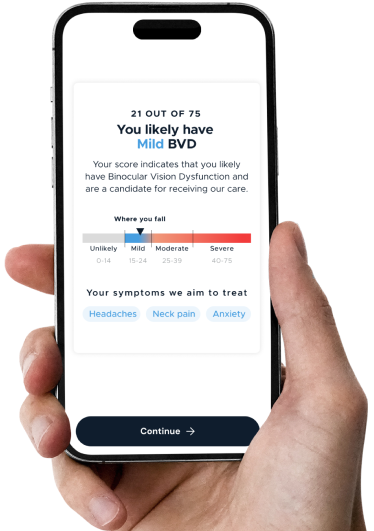
Prism contacts may be an option in limited cases, but many BVD patients still benefit from prescribed prism glasses. Take our BVD assessment to understand your options and start your road to recovery with Vision Specialists today.
Frequently Asked Questions About Prism Contacts
1. Do they make prism contacts?
Yes, prism contacts do exist. They are specialty contact lenses that may be designed with prism correction to help manage certain types of double vision or eye alignment problems.
2. Can you get contacts with prism?
Yes, some patients can get contacts with prisms, but they usually require custom fitting by a specialty contact lens provider. They are not the same as standard soft contact lenses.
3. Can prism contacts help double vision?
Prism contacts may help some types of binocular double vision caused by small eye misalignments. They are not appropriate for every cause of double vision, so a comprehensive eye exam is necessary.
4. Are prism contacts available for BVD?
Prism contacts may be considered in select cases, but many patients with BVD are better treated with prism glasses or micro-prism lenses because these allow for more precise and adjustable correction.
5. Are prism contacts the same as prism ballast contacts?
No. Prism ballast is commonly used to stabilize certain contact lenses, such as toric lenses. Prism contacts for double vision use optical prism to help align images between the eyes.
6. Can I wear prism glasses over contact lenses?
Yes, some patients wear regular contact lenses for vision correction and prism glasses over them to help with eye alignment symptoms. This may be an option for contact lens wearers who need prisms but do not want full-time glasses.
7. Are prism contacts better than prism glasses?
Not always. Prism contacts may be helpful for select patients, but prism glasses are usually easier to adjust and may be more appropriate for BVD, subtle misalignment, or changing prism needs.
8. Who is a good candidate for prism contacts?
A good candidate may have binocular double vision, stable eye alignment measurements, healthy eyes for contact lens wear, and a relatively small prism need. A specialist must determine candidacy after a full evaluation.